Showing posts with label Passover. Show all posts

Thursday, April 5, 2012

A MANDEL BREAD FOR ALL SEASONS

Many of the desserts that are kosher for Passover are takeoffs on everyday desserts, substituting matzoh cake meal for traditional flour. And they taste like it. And therein lies the problem. I find the key to avoid having this happen is to throw caution to the wind and prepare desserts that embrace the nutty matzoh taste rather then fight it.
The Mandel Bread (Jewish Biscotti) below does not taste like traditional Mandel Bread...but in a good way. It's a tasty cookie in its own right, and not an "okay so it's Passover and we'll deal with it" stand-in for a cookie. Not only does the recipe contain matzoh cake meal, but it also contains some potato starch which, acting a little like cornstarch, will tenderize the texture a bit. It also contains some coarse matzoh meal to give the cookies a little crunch. This is an easily adaptable recipe, and choosing add-ins such as chocolate chips, nuts, dried apricots, raisins or berries will also enhance the flavor and make it your own. The one absolute here is baking the loaves once, allowing them to cool, and then slicing and baking them a second time. This second go round in the oven   crisps up the cookies and brings the cinnamon/sugar coating to the forefront. The matzoh flavor is still there, but as a secondary flavor. 


The Mandel Bread freezes well, so you can whip up a few batches at the beginning of the holiday, and have enough to last for the rest of the eight days that follow. Because Lord knows, anything that lessens your time in front of the stove or oven during this holiday is a lifesaver.
PASSOVER MANDEL BREAD
(makes two loaves)
scant 3/4c. oil
1 Tbsp. veg. shortening or butter, softened
1 1/4c. sugar
1 egg yolk
3 whole eggs
1/2c. orange juice
2 Tbsp. orange zest
2 3/4c. matzoh cake meal
3/4c. potato starch
1/2c. matzoh meal
1/2 tsp. salt
1 tsp. cinnamon
Add-ins: 1c. dark chocolate, chopped
               1c. milk chocolate, chopped
               1c. chopped walnuts or almonds
               1c. dried cherries
               1c. dried apricots, chopped
Cinnamon/sugar, for sprinkling (1/2c. sugar + 1/4c. cinnamon)
Line a sheet pan with parchment paper and set aside. Preheat oven to 350 degrees.
In the blow of an electric mixer, fitted with the paddle attachment, cream oil with the softened shortening or butter. Add eggs, sugar, and orange zest and continue to mix for five minutes, until light and fluffy.
Reduce speed to low and add orange juice. Mix until combined and slowly add dry ingredients. Mix  at medium speed until all are combined. Reduce speed again and mix in add-ins of your choice. Once everything is combined, turn dough out onto an ungreased surface and knead for a few minutes. Form dough into two loaves, approximately 4 inches long. Place on prepared baking sheet, flatten them down a bit, and sprinkle tops with a few spoonfuls of cinnamon/sugar. Bake for 30 minutes, rotating pan at the halfway point.
Once the loaves are baked, remove pan from the oven and allow them to cool for ten minutes. Slice the Mandel Bread into 1/4” slices, and place the slices down flat on a cooled sheet pan. Sprinkle liberally with cinnamon/sugar a second time and bake again for 10 minutes, until slices are nicely browned.
                

Monday, April 2, 2012

THE BIG MAC(aroon)S OF PASSOVER

I’ve never been a big fan of the traditional Passover macaroon, and perhaps that has something to do with the fact that I am not a big fan of coconut. (Or maybe it’s the fact that the little dried-up nubbins that come out of a can have been sitting on the supermarket shelves for weeks before the holiday even begins.) Actually, it’s not the flavor of the coconut that I don’t like, it’s more the stringy texture of the strands   
Passover is a lot like Thanksgiving in that some people just need and expect to see certain things at the traditional dinner year after year, so the presence of macaroons is often non-negotiable. The coconut in the macaroons below is combined with almond flour, thus producing a texture that is more cookie-like in the center. When I bite into one, I get creamy coconut flavor rather than a mouthful of fibrous strands. Baking them until they’re golden brown produces a sweet, crackly surface. Dipping the bottoms in dark chocolate offsets the sweetness and adds another dimension to the flavor. These Macs are more than good enough to maintain their yearly place at my Seder table, without any grumbling on my part.
By the way, those canned macaroons that I mentioned earlier have some purpose too. They can be pulverized in a food processor and combined with softened butter to be used as a crust for a Passover Pie. (But that’s another story.)
MACAROONS
(adapted from Oh Nuts!)
(makes 12-15)
4 egg whites, at room temperature
1 1/4c. granulated sugar
1/2 tsp. salt
1 Tbsp. honey
2 1/2c. shredded coconut
1/4c. almond meal
1/2 Tbsp. matzoh cake meal
1 tsp. kosher for Passover vanilla extract
8 oz. dark (60-64%) chocolate, melted (opt.)
Combine the almond meal, egg whites, granulated sugar, salt, honey, coconut, and vanilla extract in a medium-sized saucepan.
 Stir the mixture over medium-low heat until sugar has dissolved and egg whites turn milky--between 5 to 7 minutes. Continue stirring until all is incorporated and mixture thickens.

Once mixture holds together, remove pan from heat and stir in the matzoh cake meal. Scrape mixture into a bowl and allow it to come to room temperature. (The bowl can also be covered with plastic wrap and placed in the refrigerator for later use.)
When you're ready to bake, preheat the oven to 325 degrees. Line two baking sheets with parchment paper, and using a cookie scoop or a tablespoon, measure out 12 to 18 mounds of mixture.  
With moistened hands, pinch and press each cookie into a triangular, pyramid shape, being careful not to make the tops too pointy. Bake the macaroons in the preheated oven for 18-20 minutes, rotating them halfway during the baking process.
Once the cookies have cooled completely, you can dip the bottoms into the melted dark chocolate. Place them back on the cooled baking sheet to set. They can be stored in an airtight container in the refrigerator for up to a week, or (without the chocolate) in a well-sealed container in the freezer for up to a month.

Wednesday, March 28, 2012

PASSOVER COCKTAIL PARTY (Cheese Sables)

The concept of having a cocktail party during Passover is one that is not often considered given all the dietary restrictions, but that doesn’t mean it is an impossible undertaking.  There are many fine kosher for Passover wines, and recently I discovered a brand of gin that is K for P as well. So, bring on the martinis!
Now that we have the drinks out of the way, deciding what small tidbits to serve (and which can be served) is easy. There are many holiday friendly cheeses that could find their way on a lovely cheese platter. Scatter some dried fruits such as figs and apricots around, and add some bowls of spiced almonds and cashews (peanuts might be a no-no for some folks). Corn is not a Passover-sanctioned food, so corn chips are out, but potatoes are on the approved list. You can pair homemade potato chips (or store-bought ones) with a caramelized onion dip like this one, and your guests will be thrilled. For some color, the bowl of dip can be placed in the center of a platter of beautifully blanched asparagus spears, baby carrots, cherry tomatoes, and broccoli florets.  Since this party is in a no-meat zone--cheese, that is dairy, is being served, and we are not mixing milk and meat products here--a variety of fresh salsas, both sweet and savory would also be flavorful additions. They can be served with sheets of whole-wheat and egg matzohs that have been broken into random shards.
A new addition to my cocktail party this year will be savory sables (sa-blays), buttery cocktail cookies. The recipe is a variation on the theme from the monthly #baketogether group that is initiated by Abby Dodge. Abby’s original recipe called for Parmesan cheese and a bit of cayenne pepper. I have taken the liberty of making it kosher for Passover by substituting a combination of matzoh cake meal and potato starch for the flour. I’ve also added a Latin flavor substituting Manchego, a Spanish sheep's milk cheese and smoked paprika (pimenton). In the preparation of making this dough, Abby introduces a technique called “fraisage." It is typically used when making pie dough and other flaky doughs and creates layers of flour and butter. It is not too difficult to master, and it makes the world of difference in the texture. 


While the cake meal/potato starch mixture does not create as sandy a texture as the traditional flour, I think this is still a pretty darn good kosher for Passover stand-in. In fact, these sables are good enough to serve outside a cocktail party--with just a glass of one of those great Passover wines that are in the markets now.
PASSOVER CHEESE SABLES
  • 1 1/3 cups (6 ounces) matzoh cake meal
  • 1 Tbsp. potato starch
  • 1/2 cup (2 ounces) grated Manchego cheese (or other sharp kosher for Passover cheese)
  • 1/2 teaspoon table salt
  • 3/4 teaspoon chopped fresh thyme
  • 1/2 teaspoon (or more to taste) smoked paprika (pimenton)
  • 8 tablespoons (4 ounces) unsalted butter, cut into 7 slices, well chilled
  • 2 tablespoons + 1 1/2 teaspoons very cold water
To make the dough:
1. Put the matzoh cake meal, potato starch, cheese, salt and paprika in a food processor and pulse briefly to combine. Add the butter and pulse until the butter pieces are slightly larger than pea size, about 10 to 12 pulses depending on your machine. Drizzle the water evenly over the flour mixture. Pulse until the dough begins to form moist crumbs that are just beginning to clump together, about 8 or 9 more pulses depending on your machine.
2. Dump the moist crumbs onto the unfloured counter and gather into a pile. With the heel of you hand, push and gently smear the crumbs away from you until they start to come together in a cohesive dough. Two or three ‘smears’ should do the trick. Using a bench scraper, gather the dough together and turn it about 45 degrees and give it one or two more smears.  Gather the dough together and shape the dough into a 7 1/4-inch long cylinder. Wrap tightly in plastic wrap and refrigerate until very firm, about 3 hours, or up to 2 days.
3. Position a rack in the center of the oven and heat the oven to 375°F.  Line two large baking sheets with parchment. Using a thin, sharp knife, cut the logs into 1/4-inch slices and arrange about 1 inch apart (they don’t spread much at all) on the prepared sheets. Bake, one sheet at a time, until nutty brown around the edges, 16 to 18 minutes. Serve slightly warm or room temperature.
4. The dough can be shaped and frozen for up to a month and then thawed for about an hour on the counter or in the refrigerator overnight. Likewise, tuck the baked and cooled sables in a heavy duty zip top bag and stash them in the freezer. Thaw at room temperature and warm them for a few minutes at 325°F to refresh the flavors.

Tuesday, March 20, 2012

PASSOVER BREAKFAST

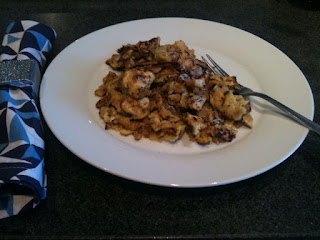
My dad was not a cook. He built skyscrapers in New York City, and his strong hands were more comfortable wielding the heavy steel of a hammer or a saw, than the gentle curves of a metal whisk. He was more adept at hoisting large wooden planks than swirling a wooden mixing spoon inside a soup pot.  I’d never seen him bake a cake or make a goulash like my mom, but for many years during my childhood, he rose even earlier than usual--which was at the crack of dawn--during Passover and prepared Matzoh Brei for my sister and myself. Matzoh Brei can be defined as Jewish French Toast with the matzoh substituting for the bread. Most Jewish households, regardless of whether they strictly observe the dietary restrictions of Passover or not, have their own way of preparing the dish. Some like it savory, in the shape of a pancake or a frittata, a little more on the eggy side, a little less. We had our own specifications and Dad’s way met every one of them. I have no idea where he got his recipe. It may have been my mom’s but hers never seemed to taste the same. And even when he would sometimes prepare it for us on the weekends, that Matzoh Brei just wasn’t as perfect.
Because his weekday ritual occurred so very early in the morning, we never saw him in his cooking mode, not even a glimpse. By the time we awakened, he was long gone, having taken the subway into the city. The wonderful breakfast treat he left behind was often on the stove, in a well-used nonstick skillet, covered with an inverted green milk-glass dinner plate. (This was our Passover dinnerware. And in spite of the fact that it was used every year for only eight days and nights, eventually, the entire set dwindled down to a mere few soup bowls.) 
While Dad’s prowess forty and fifty stories above the streets below was based solely on precision, his techniques in the kitchen were less so. Measuring spoons and cups were not for him. He would pour warm water into a metal mixing bowl (a “shissel”) and add the matzohs whole, breaking them up into random shapes with the back of his hand. We girls loved the smaller bits that became browned and crispy as they were fried, so Dad made sure we had lots of them. He soaked the matzoh pieces just until they became soft--too soft would be disaster. While they soaked and the pan was heating, he would take a large spoonful of “schmaltz,” rendered chicken fat, from a jar in the fridge. This was his secret ingredient; it was a staple in our house. (Dad would also slather it on his rye bread with abandon--he obviously was not too concerned with cholesterol, and I’m not certain whether he had reason to be anyway since he was always the picture of health.) 

The cream-colored dollop of fat would hiss as it plopped into the hot pan, eventually melting and coating the bottom. As it heated, it made low popping noises. The softened matzoh was gently combined with beaten egg, and then the yellow, glistening pieces were dumped into the hot, hazy fat. Once the entire concoction was browned, he would flip it and then brown the other side. Only then did he break up the pieces again with the back of a wooden spatula, and douse the top with a healthy shake of sugar. That snowy dusting soon became a crunchy, caramelized coating that my sister and I loved so much.
My dad was not a very demonstrative man, and to the outside world he may have even appeared gruff. He showed us love in more ways than I can say, but they were on his own terms. Back then I never thought about what he thought as he prepared this dish for us in the darkened kitchen while everyone else slept, and the sound of the clock ticking was the only sound he heard. This act was not one of obligation, but as I realize now, it was an act of sincere love--and just another way of him showing us, on his own terms.

As I said, my dad really didn't adhere to a recipe when making his Matzoh Brei. The closest one I found is from Joan Nathan's "Jewish Holiday Cookbook." It is a little light on the egg-to-matzoh ratio, and makes for a crispier end product. (That's how we liked it!) Additionally, butter or vegetable oil can be substituted for the chicken fat. (I will tell you that since I left my dad's house, schmaltz has never darkened my dooorway, but I am seriously considering making some just for this purpose.) If butter is used, the meal becomes a dairy meal, and in a kosher home such as ours was, it could not be served with any meat products. Just as Dad's version could not be served with any products containing milk.

                                                 MATZOH BREI

3 matzohs
2 whole eggs, beaten
1/2 tsp. salt
2 Tbsp. chicken fat, butter, parve margarine or vegetable oil
1/4c. granulated sugar
cinnamon, cinnamon/sugar, for topping

Pour warm water into a large mixing bowl. Place the matzohs in the bowl and break into pieces. Allow to soak for a few minutes. Drain and gently squeeze the matzohs dry.
Pour the fat of your choice into a large nonstick skillet and heat over medium heat.
Place the matzohs back in the bowl. Add the beaten eggs, salt, and half of the sugar. Mix well, without crumbing the matzoh.
Brei and the pieces have all browned, turn mixture out on a large platter.
Serve with additional sugar or cinnamon/sugar, if desired.